As another backpacking season approaches, I would like to take stock of where we currently stand with regard to our trails and the federal public lands where they are found. Not only do these trails depend on land, they also depend on shared resources that do not abide by borders, such as clean air, water, and a stable climate.
A quick refresher on some federal agencies and who is now in charge of them:
The federal agencies entrusted with managing our public lands are the Bureau of Land Management, the Forest Service, and the National Park Service. These three agencies differ in their missions. All three provide recreational access, and all three may include designated wilderness areas within their boundaries. Wilderness represents the highest level of protection afforded to our federal public lands.
Traditionally, the BLM has supported mining and grazing, while the Forest Service has supported logging and multiple-use land management. The primary mission of the National Park Service is preservation, along with light recreation (no off-roading or guns, for example).
The BLM and NPS reside within the Department of the Interior (under Secretary Doug Burgum). The Forest Service resides within the Department of Agriculture (under Secretary Brooke Rollins).
In short, Doug Burgum looks at a canyon the way a raccoon looks at an unattended cooler. He is also big on land swaps that favor the ultra-rich and oil leases for his cronies. Brooke Rollins helped plan the policy agenda for a second Trump administration and previously served as Rick Perry’s ethics advisor, which is a little like serving as the nutritionist aboard a Carnival cruise.
Neither speaks for the trees or the trails. The Lorax be damned.
One recent victory we can celebrate is that the current administration failed in installing a Delaware North executive as National Parks Director. Delaware North is one of the largest privately owned hospitality and entertainment companies in the world.
The current director of the National Park Service is an interim director from inside the National Park Service and a career bureaucrat. They are responsible for carrying out Trump’s directives to culturally sanitize the educational efforts of the National Park Service.
Tom Schultz, who now directs the National Forest Service, comes to us from the logging industry and is a man who “can’t see the forest for the trees.”
The BLM now has a new director: Steve Pearce. Pearce is a former Republican congressman from New Mexico and comes to us from the oil and gas industry, which at least saves everyone the trouble of now pretending that the BLM is concerned at all about conservation. Pearce will be using the Congressional Review Act to roll back protections for National Monuments.
The CRA is a federal law that allows Congress to overturn certain agency rules by passing a joint resolution of disapproval with a simple majority vote in both houses. If the president signs the resolution, the rule is nullified, and the agency generally cannot issue another rule that is “substantially the same” without new authorization from Congress.
The foxes are no longer merely in the henhouse. They are now conducting a market analysis of the hens. The dismantling and liquidation of our natural resources is under way. Corruption and cronyism rule the day. The end game is to concentrate as much wealth in as few hands as possible.
Regarding access to our public lands: if you need to obtain a Wilderness Permit for hiking in the woods or want to reserve a public campground, you can do so by logging onto Recreation.gov, which is run by Booz Allen Hamilton. Booz Allen Hamilton is a cybersecurity firm that partners with the DHS and DOJ to keep our borders secure and is listed as a private donor to the White House Ballroom project. Yet they don’t seem able to keep bots out of the campground reservation system. Their fee to make and/or cancel a reservation is hefty. For this reason, many people do not bother to cancel when something comes up. As a result, when you visit a popular campground, the sign always reads “campground full,” even if half the sites are actually empty. Think of it this way: somewhere in a Bay Area suburb a father is gallantly protecting Site #78 from unnecessary occupation.
Edward Abbey long warned that public land agencies too often functioned as quiet partners of extraction industries. Today they appear increasingly uninterested in the quiet part.
Each morning, the conscientious reader encounters a litany of truly alarming ideas that, within the current political climate, are presented as reasonable. For example, a $10 billion, 1-gigawatt data center near Horseshoe Bend in Page, Arizona has been proposed—one mile from this:
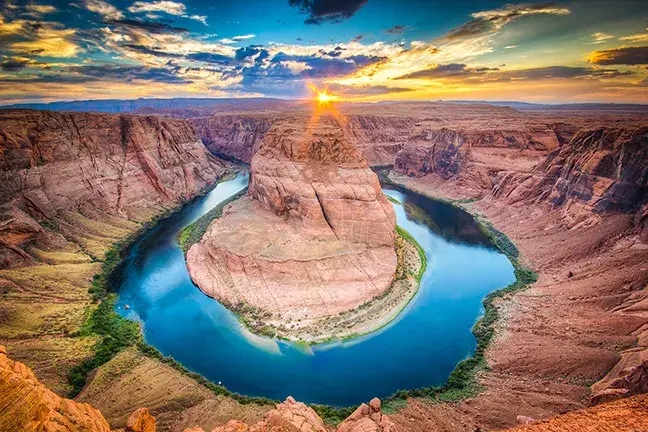
Sidenote: Early in 2025, a 2023 AI executive order was revoked, which had required extensive safety reporting and testing for advanced AI systems. The replacement policy emphasizes accelerating AI development, reducing regulatory barriers, and expanding data-center construction. The current administration has some interest in controlling AI, but not for the purposes of safety and sustainability.
So here is where we currently stand:
BLM staffing has fallen 20 percent since 2025. Much of that loss represents senior expertise. Funding remains flat, with proposals on the table for future budget cuts. The Public Lands Rule of 2024, which elevated conservation to equal footing with mining, has been eliminated. That rule prioritized ecosystem resilience, landscape restoration, and Indigenous knowledge in management decisions.
The Forest Service has seen a similar staffing reduction of around 20 percent. Funding here also remains flat; however, fire suppression funding has increased while support for nearly everything else has declined. In practical terms, this means more money will be spent on timber harvesting and mechanical thinning. This will be paired with expedited environmental review and is often framed as wildfire risk reduction and forest health. Less money will be spent on recreation and science.
The Forest Service’s Roadless Rule of 2001 is also in the process of being repealed. This regulation protects nearly 58.5 million acres of undeveloped national forest from logging, mining, and road construction. It was intended to preserve ecological, recreational, and water resources across nearly 30 percent of National Forest System land.
By far the most sweeping change to public land management in the United States right now is a major reorganization of the Forest Service.
The Forest Service’s nine regional offices will be shuttered. The Forest Service headquarters is being moved to Utah, where opposition to federal land ownership is practically a native plant species.
The Forest Service also plans to close 57 out of 77 research facilities nationwide, undermining critical science on wildfire, drought, and ecosystem health at a time when it is needed most.
These changes are part of a broader strategy to reduce capacity, push out expertise, and weaken the Forest Service’s role in national public lands policy.
Last but not least, the National Park Service has seen its staffing cut by 25 percent while funding remains flat. The 2027 budget proposal calls for an additional 25 percent reduction to park operations. The mission has shifted from stewardship to access. Science, conservation, and education programs are being eliminated. There will be fewer backcountry rangers as personnel are reassigned to front-facing roles.
We can also expect to see increased industrial activity near national park borders. For example, the Endangered Species Committee, commonly known as the “God Squad,” voted unanimously on March 31, 2026, to exempt all oil and gas drilling in the Gulf of Mexico from the Endangered Species Act. This decision effectively allows expanded drilling operations in waters home to ten National Park sites, including the Gulf Islands National Seashore and Everglades National Park.
Upon returning from a recent trip to Yosemite, I noticed that the entrance gates were not fully staffed, allowing visitors to come and go without paying entrance fees. Meanwhile, the historic Wawona Hotel and its complex of historic buildings (totaling seven structures) have been closed indefinitely. It will cost between fifty and one hundred million dollars to fully refurbish the site. That’s around 25 Tomahawk cruise missiles. The U.S. military has used over 1,000 Tomahawk cruise missiles in the war with Iran so far—to little effect.
Memorial Day weekend was a stress test for Yosemite National Park as the reservation system was eliminated by the current administration. Without any limit to how many people could enter the park on any given day, Yosemite Valley was quickly flooded with people illegally parking their cars on meadows and overwhelming the trails and facilities.
Broadly speaking, federal protections for clean air and water are being rolled back.
Our climate is becoming far more unstable. Just last March, the western United States experienced a record-shattering high-pressure system (a “heat dome”) that lasted for over a week. This intense, stagnant ridge set new temperature records across the West. Much of our Sierra Nevada snowpack melted. California’s coastal waters warmed.
Every day there is something new. The attacks are relentless. It feels like a feeding frenzy. It reminds me of some folks I overheard last year at Glacier Point in Yosemite. They were discussing whether or not to step over the guard rail to get a better view of the valley three thousand vertical feet below. One of them said, “We can do whatever we want now! Trump is president!” So yes, the guard rails may still be in place, but they are increasingly being ignored.
Remember what I said earlier about how public lands represent the core of our democracy? It was on the frontiers of this nation that many of our uniquely American characteristics were formed, for better or worse.
Have you noticed the recurring figure of 20 to 25 percent staffing and funding losses across all three agencies? Funding for public lands is not the only thing that is eroding.
Our U.S. democracy has experienced a similar rapid decline.
At this rate, democracy may only survive as a historic interpretive exhibit staffed by volunteers on alternate weekends.
As part of this multi-pronged attack, science and education are also being phased out. They are both increasingly viewed as threats because they have a habit of distributing knowledge more broadly than concentrating wealth.
Even so, I do feel confident that the Wilderness Act will remain intact and that our existing wilderness areas will maintain their borders. The same goes for our National Parks. National Monument boundaries, unlike National Parks, remain vulnerable to executive action.
There is little in the way of federal action regarding hiking trails and public lands to celebrate, other than the continued existence of The Land and Water Conservation Fund. But if we look beyond that, there is good news.
The Good News
- Volunteer stewardship is expanding rather than shrinking.
- California is expanding its state park system, not shrinking it.
- California continues pursuing its goal of conserving 30 percent of the state’s lands and coastal waters by 2030.
- Wildlife crossings are becoming reality. The famous Wallis Annenberg wildlife crossing in Southern California is nearing completion and is expected to open to wildlife later in 2026.
- The Great Redwood Trail—the ambitious rail-to-trail conversion that will eventually stretch roughly 320 miles through Northern California—is still advancing.
- In and around Downieville, the Sierra Buttes Trail Stewardship has been driving what’s called the Lost Sierra Trail, a 600-mile multi-use trail.
- I recently learned that Adirondack Park is one of the largest parks in the nation, and it is not even a National Park!
- The Klamath River restoration is now widely considered the largest dam removal and river restoration project in U.S. history.
- Colorado has quietly become one of the most ambitious states in the country regarding trails, wildlife connectivity, and outdoor access.
- In April 2026, New Mexico awarded nearly $6 million for trail and outdoor infrastructure projects affecting more than 355 miles of trails across 21 counties, with a strong emphasis on rural and Tribal communities.
- Washington (state) is expanding its state parks.
- Wisconsin is expanding and protecting its iconic trails.
- Michigan is building a state-wide trail identity.
- The Walton family has transformed Northwest Arkansas—especially around Bentonville—into what is arguably the premier mountain biking destination in the central United States.
- Some rich people are stepping up: people like Kristine Tompkins, MacKenzie Scott, Hansjörg Wyss, and Yvon Chouinard.
- If I had to point to one place on Earth where the conservation story is most inspiring right now, it would be Chilean Patagonia. The Tompkins conservation effort has already created seven national parks, expanded three others, and protected more than 11 million acres. The resulting “Route of Parks” forms one of the largest protected landscape networks in the world.
- Argentina is quietly expanding protected areas.
- Europe is experimenting with large-scale rewilding.
- Internationally, wildlife crossings are becoming common.
- In western Colombia, regions once shaped by armed conflict are now sustained by ecotourism.
- Eight crested ibises were released into the wild in a north-central Japanese town, decades after the birds went extinct in the country.

The trails ahead remain open. The question is what kind of country will they pass through. I do know that I don’t need to hike through a new ballroom, nor hike under a new golden arch, and I don’t care if the reflecting pool is blue or green.
Granite does not respond to tyrants. It remains stubbornly itself, indifferent to hate. There is comfort in that.
I look forward to checking back in with you one year from now to once again take stock. I remain optimistic.
In the meanwhile, I will continue to seek kindness, beauty, and humor wherever I venture. I hope you do as well.

 "Trail Reports"
One thought on “Taking Stock of Our Trails”