Last Saturday, Karen and I met up with representatives from both the Sierra Club and the Beaver Brigade to visit some beaver dams on the Salinas River. These dams are five miles from our house as the crow flies. We were joined by around ten other people, old and young alike. Our guide was a wise and knowledgeable thirty-year-old named Raine.
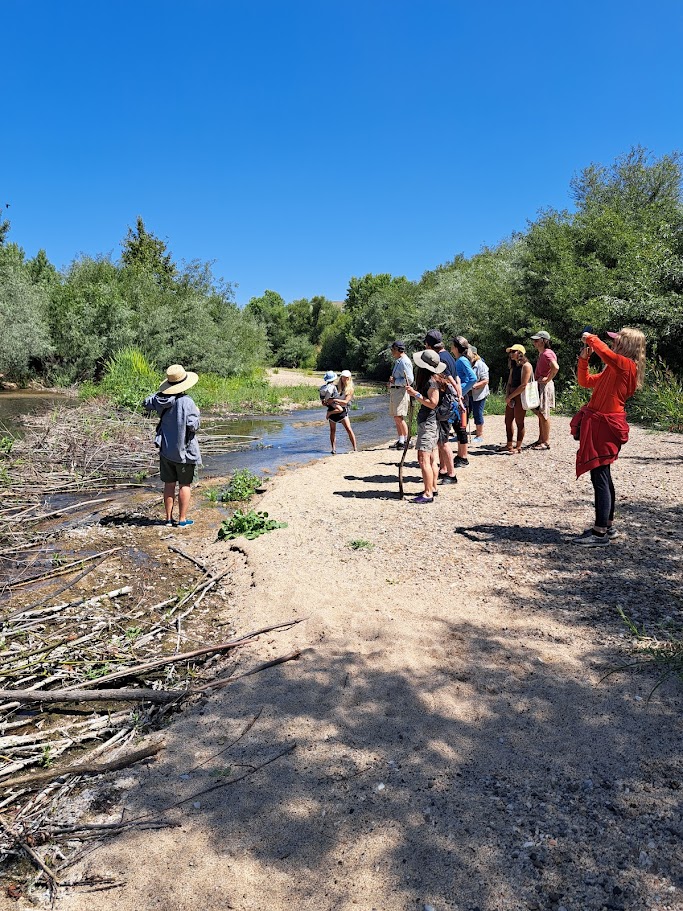
I did not know what to expect. I guess I was a little skeptical about the existence of beavers along this particular stretch of the Salinas River, which I would describe as “ecologically challenged.” I had heard rumors of Beavers returning to the area, but I had dismissed them. Locals will tell you that they used to be common. Then they left. Now they were back? I found it hard to imagine.
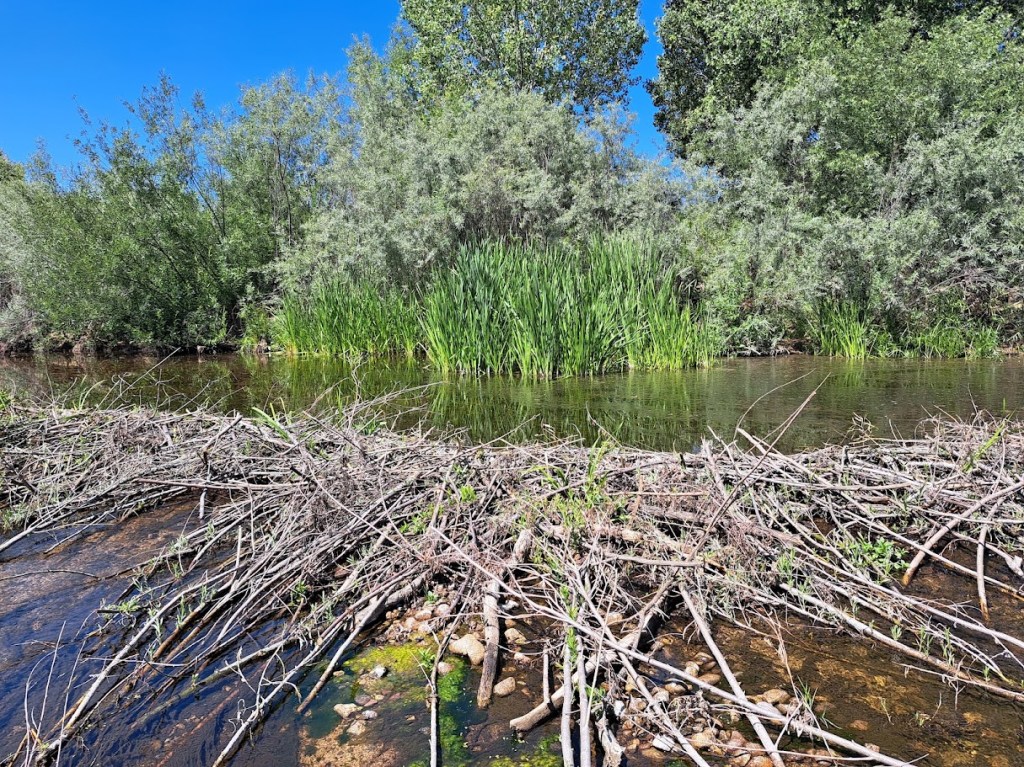
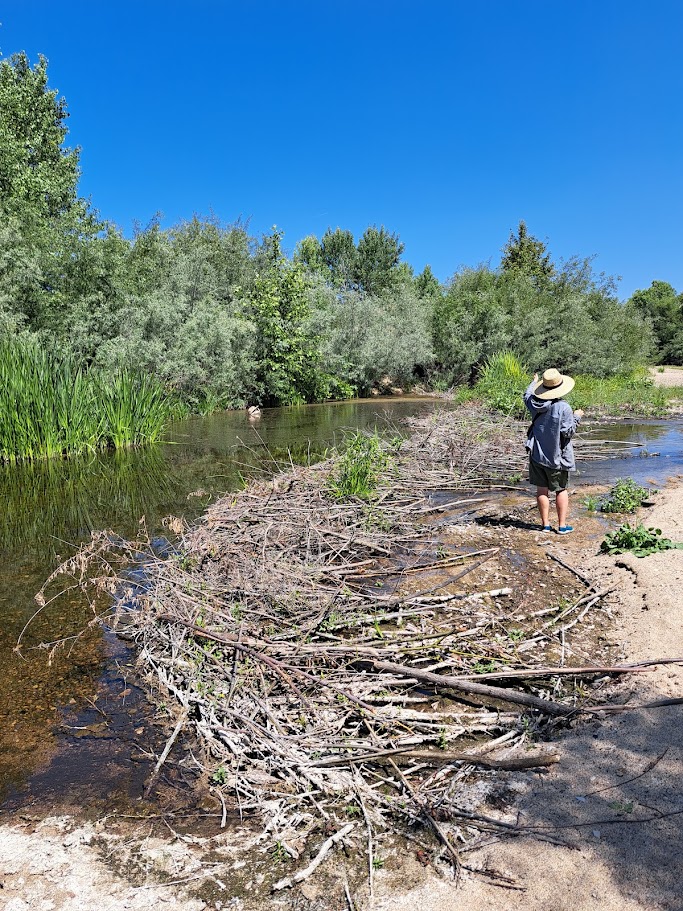
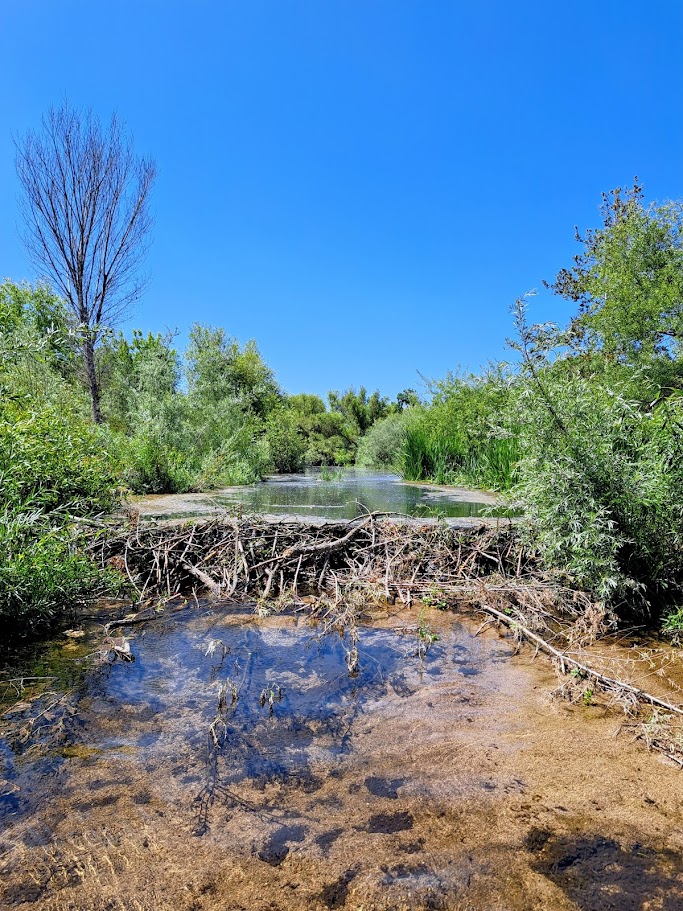
We walked about one mile before encountering the ponds created by the beaver dams. Although the beavers were hiding, what they engineered was truly an oasis.
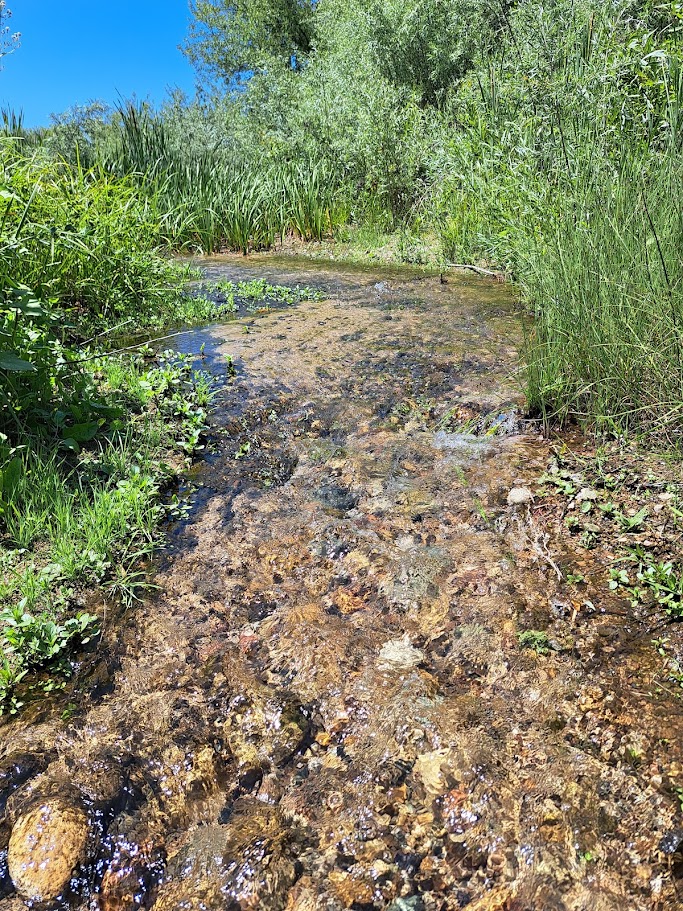
It was noticeably cooler. There were numerous birds. Small fish and pollywogs filled the water. Aquatic plants were thriving. The beavers had constructed numerous dams that slowed the water and allowed it to pool. They also stimulate plant growth with their constant gnawing. They even plant willows. If a beaver wants to plant a willow in the riverbed, it doesn’t need a permit. It just gnaws off a willow branch and shoves it into the sand.
The river has reaped a huge benefit from the beavers. The upper Salinas River tends to fill in the winter, then flood and run fast and hard. Later, in the summer, it might dry up completely. The beavers help retain water in the riverbed during the dry summers, which not only helps the plants but helps everything.
Prior to European colonization, beaver populations in what is now the U.S. numbered in the hundreds of millions. They were important shapers of our landscape and ecology.
Without a beaver is a river even a river?
During the late 1800s and early 1900s, they were nearly extirpated. They began a natural re-expansion into the upper Salinas River beginning around 2005. Locals believe they abandoned this stretch and moved north (downstream). I am amazed that they have returned. And now that they have, a small army of human protectors is emerging. What is the most important tool of the Beaver Brigade? Education!
Raine spoke about how she does not look forward to waking up and reading the news to learn what has changed in the world today. It is seldom encouraging. What she does look forward to is walking out to the beaver dam to observe what has changed—to discover what is new and different. Beavers are very busy. They are constantly manipulating their environment. “They know what they are doing,” states Raine. “We don’t always understand what they are doing, but they do.” She also looks forward to meeting new people on the many walks she leads.
I’ve been taking stock of where we stand regarding the trails on our federal public lands. I wrote a Trail Report about it (“Taking Stock of Our Trails”). At the federal level, there is very little encouraging news. I stay up to date on these issues, even though it is discouraging. Yet, I refuse to look away. I refuse to stick my head in the sand.
I was feeling saddened by my recent analysis prior to my nature walk with Raine and the others. Afterward, I was filled with hope and optimism. Hers is such a simple recipe. She looks forward to visiting the beaver ponds to see what is new and exciting, not the front page. She engages with good people.
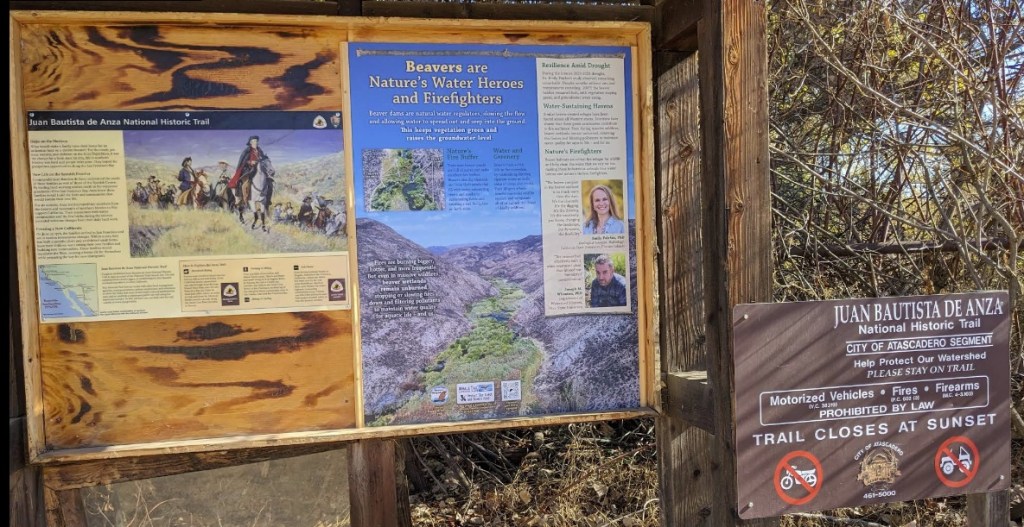
And then there are the beavers. They chose to return to this area of their own accord. They were not reintroduced by humans. Yet they came back. We don’t know why, but we are thrilled. A very important driver may have been that the City of Atascadero passed a prohibition against private motorized vehicles in the riparian corridor of the Salinas River in 1992. Around the same time Congress designated a National Trail that runs along the river bed: the Juan Bautista de Anza National Historic Trail. (De Anza camped here in March of 1776, very close to the beaver ponds.) The use pattern is shifting away from off road vehicles and towards hikers, cyclists and equestrians. Volunteers have also erected educational signage about the beavers at various trailheads.
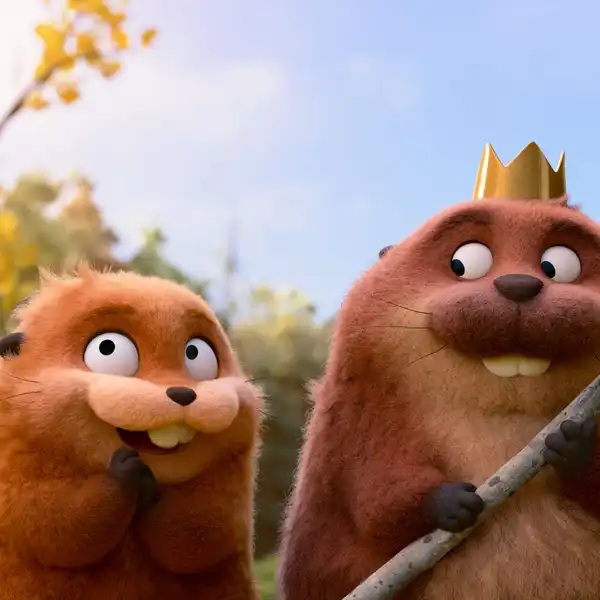
Attitudes are changing. A few decades ago, a movie like “Hoppers” might have been a tough sell. In the Pixar movie, beavers and their habitat are central to the story. The protagonist uses technology to transfer her consciousness into a robotic beaver and becomes involved with a community of animals led by a beaver named King George. A major plot element involves protecting wildlife habitat from human development.
And you have probably heard about the Czech beavers. The Czech government had been planning since 2018 to build a series of small dams and water-control structures in the Brdy region, southwest of Prague, to restore wetlands and improve habitat. The project became bogged down in permits, land-ownership issues, and administrative delays. Then a family of Eurasian beavers moved in and built dams in essentially the same area, creating the wetland the project was intended to produce. Officials estimated the beavers saved roughly 30 million Czech crowns.
In short, beavers act as natural ecosystem engineers that restore and maintain wetlands, improve water storage and quality, reduce floods and wildfire impacts, enhance biodiversity and habitat complexity, support fisheries and recreation, and provide major economic benefits. And they are damn cute!
Interestingly, nearby on the Cal Poly campus, work is being done by humans to restore a degraded creek. How are they doing that? By building beaver dams out of mud and sticks. These human beaver dams have a fancy acronym: BDA, which stands for “beaver dam analogue”. Human beavers!
Raine reminded me what a good Trail Report is usually about: heading out into the natural environment to discover and explore, meet new people along the way and hopefully learn something. Sometimes hope is no farther away than a short walk down a trail.
Thank you for reading. Feel free to share.
You can read “Taking Stock of Our Trails” by clicking this link: https://daveboicourt.com/2026/06/05/taking-stock-of-our-trails/
And you can find all my Trail Reports at daveboicourt.com.

 "Trail Reports"
How often does the beaver brigade meet? Didn’t even recognize the salinas from your photos
LikeLike
Here’s their info:
Come to a beaver pond – SLO Beaver Brigade
https://share.google/kGlVW5MVSXTij5Rkb
LikeLike
Spoiler Alert: “Hoppers” is a terrible movie. After finishing this Trail Report, I decided I should watch Disney’s latest Pixar movie. I wish I hadn’t. It was very disappointing.
I was encouraged by the fact that Disney hired renowned beaver expert Dr. Fairfax to consult on the movie. All she succeeded in accomplishing was a compromise wherein Disney agreed to the beavers having yellow teeth. (Disney wanted white teeth, while real beavers’ teeth are reddish.)
All the forest creatures in the movie have retreated to one giant beaver pond. The first beaver we meet is a complete idiot. And although the forest creatures appear to be living in harmony, they are allowed by “pond rules” to eat each other whenever they get hungry. Finally, it turns out the evil villain of the movie is a caterpillar. So lame.
I would have allowed the forest creatures their rage at being displaced and would have allowed Mayor Jerry to be the tool that he was. Mabel’s job should have been to constructively interface between the two groups in order to arrive at a compromise. She could have done this by kidnapping Mayor Jerry, placing him in the “hopper,” and allowing him to build empathy while being forced to live as a beaver for a few weeks.
I raised my kids on Pixar: Toy Story, Monsters, Inc., Finding Nemo, The Incredibles, Cars, Up, Brave, and Inside Out.
When Toy Story 3 came out, my son and Andy were the same age. They were both packing up to go to college. I lost it during the scene where Andy’s room is empty except for a cardboard box marked “college.” It was a good thing we were all wearing 3D glasses. No one could see my tears!
Unfortunately, this movie couldn’t find its way out of the woods — let alone to infinity and beyond. It left me wishing I had watched WALL-E for thirty first time.
LikeLike